
| Home | Books | News | About |
Three Royal Children
Fairy tale text by Undine & Jens [2026]
Interpretation by Undine & Jens in green [2026]
For this year’s New Year’s fairy tale, we were inspired by a German film from 2019 entitled “Die drei Königskinder”. At first glance, it’s a beautiful fairy tale, a story you can simply enjoy. On second glance, it raises some questions that might prompt reflection. And on third glance, you can discover a profound message that transcends all the limitations of our ordinary understanding. We would now like to share some of the inspirations that came to mind while watching it. Many thanks to the screenwriter and the film crew!
Once upon a time, there lived a powerful queen whose husband, the king, had died. So she had to rule the vast kingdom alone.
What does this mean? A feminine nature that had lost her masculine spirit? Even today, many people live in such an external nature, one that has lost its spirit and functions only according to physical laws. Therefore, we also believe that most of nature in the entire universe is dead, because it lacks the spirit that animates it. This is our “modern worldview” of materialism. According to this view, spirit is merely a product of the brain, comparable to the software for computer hardware. A strange, if not downright bad, beginning for a fairy tale… But perhaps it will develop into something better. We cordially invite you to reflect on this with us.
For there was also a king’s son, a young and handsome prince named Alexander, who grew up over time. While hunting in the forest and chasing a deer, he met a beautiful peasant girl. They fell madly in love and decided to marry. The queen would have preferred a proud princess who would rule according to her wishes. But she couldn’t do nothing about the power of love.
Could the prince become an “Alexander the Great” with a peasant girl? Whom has he found in nature? Perhaps the soul of nature? It’s not for nothing that they say, “One glimpse of our true soul, and we are immortally in love.” And who has found her? Is a far-sighted reason awakening in the young king? Is the paternal spirit, in a sense, being revived? Is the rule of external Mother Nature, with all her prevailing natural laws, thus threatened? What kind of rule is that?
The old queen was not pleased with her daughter-in-law, who had borne her son three children: two boys and a girl. No, the peasant girl was not to inherit the throne, and certainly not her children! So, she swapped the newborns for puppies and had her servant abandon the children in a river. He was actually supposed to kill them, but he couldn’t bring himself to do it. Later, the hard-hearted mother-in-law explained to the young queen that she was apparently cursed because she could only give birth to animals, and sent her to the magic mountain to break the curse. But there she was turned to stone.
There goes the living soul. And who is this servant of external nature? Is it our conceptual intellect, which serves the laws of nature? In the fairy tale film, he is called Corbinian. The name derives from the Latin “Corvus,” meaning “raven”. The raven is often used as a symbol for intellect because of its particular intelligence. Similarly, we find two ravens in the Norse god Odin, representing thought and memory, upon which the wise intellect relies, seeking its nourishment in the forest of imagination. Likewise, scientific reason tells us that we descended from apes, that our genes are almost entirely identical to those of domestic pigs, and that we essentially live like animals, only with a bit more intelligence. Similarly, the old queen convinces the young one that she has only given birth to animals, blames her for it, and sends her to her death.
But the servant entrusted the three royal children to the river, saying, “May God protect you!” Meanwhile, the young king believed his mother’s story that the three dogs were his children and that his beloved wife had died. A sad time began, but the prince’s love refused to fade. Often, like a hunter with his three hounds, he sat thoughtfully by the river, carving small dogs out of wood that resembled his supposed children, and throwing them into the stream…
But the servant also had a good heart. For just as our intellect can serve a conceptually divided world of external nature, so too it can serve a divine world of holistic reason—that is, not only the widowed queen, but also the young king. However, he could not yet rise to divine wholeness, but believed in external, physical nature, saw his mother as the reigning queen within it, and still carved inanimate figures that were meant to come alive in the river of life.
This brings a major question into the focus of the entire fairy tale: What role do animals play in our world? How can the carved figures come to life in the river of life? Why did the male spirit lack the power to do so? He likely lacked what we like to call a soul, a kind of thread of causation with which the spirit can connect and allow living reality to emerge. In this context, we speak of a “human soul”, a “dog soul”, or a “tree soul”, which is essentially just one soul as the principle of causation. Herein lies the danger of our natural science, if it does not allow for an inner soul in external nature with which the spirit can fruitfully connect. It is as if one were trying to mate with the old, widowed queen, who is no longer fertile, as external nature. Similarly, the young king had lost his fertile soul, because she was turned into stone in the magic mountain of matter.
But because nothing is lost in the divine, and it was also the wish of the good servant, the river of life carried the three abandoned royal children from the dark night of death into the vibrant, sunny world of a simple peasant couple who lived in a small garden like in a little paradise, seemingly forgotten by the world.
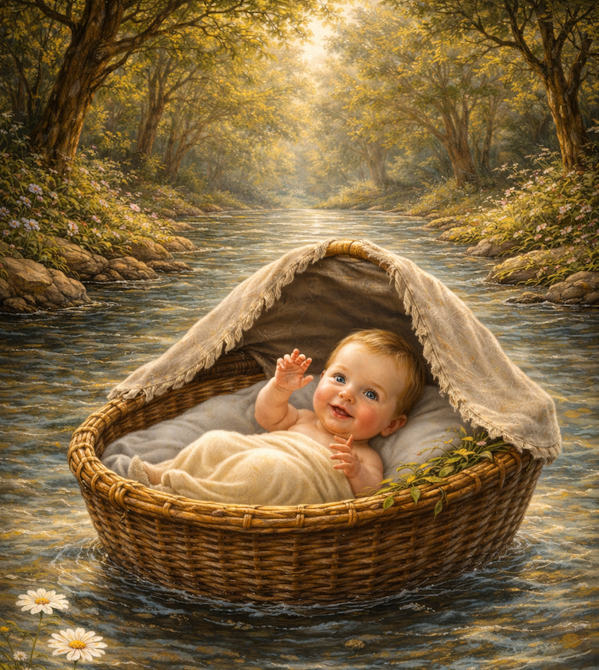
There, the children were welcomed with love, grew up strong and healthy, and learned about the simple life in nature. The eldest was named Theo, his brother Fritz, and their sister was the youngest and was called Lotte.
The farming couple symbolically reminds us of our biological parents, to whom children are given by the river of life. As long as they live naturally and simply, they are well, and they don’t ask where their children come from or why they were born.
There is much to ponder regarding the symbolic meaning of the three children. The girl could be seen as representing the mother’s soul, which is why she also bears a “birthmark” in the fairy tale film. The name Lotte is derived from Charlotte, which, interestingly, means “free man or spirit”, already hinting at the great task she is to fulfil. The name Theo evokes “God,” and Fritz “Friedrich” as “peaceful realm or ruler”, just as we speak of God and humankind. Transposed into the inner being of a person, we could think of divine, holistic reason and peaceful, rational intellect, together with the natural soul, which gives meaning and direction to this trinity. And the fact that this is about something great and divine is also suggested by the name of their mother. In the film, she is called Marie, the mother of the three royal children, which reminds us of Mary (Maria) as the biblical Mother of God.
And so, twelve happy years passed. Each child learned their task in the farming family. Theo gathered firewood, felled dead trees, and split the wood. Fritz pruned the fruit trees to keep them productive and helped his father repair the house. And Lotte learned to wash clothes in the river, fetch water, and help in the garden. Sometimes she found small carved dogs in the river, washed ashore by the current in the same places where she herself had been found as a child. She fished them out and had already found three. Working in the garden was often difficult for her. But one day, when she was supposed to dig up a small vegetable patch, she had the idea of simply letting the two family pigs onto the bed. They loved rooting in the soil and happily did the work for her. That’s how she realized how helpful animals could be. She often thoughtfully examined the carved dogs. What could they help with?
Here it is clarified how the three principles fulfil their tasks in a physical human being: Reason ensures that the withered trees in the forest of ideas are chopped up and burned. Intellect takes care of the physical body and the fruits from the Tree of Life. And the soul makes the garden of nature fertile and purifies everything impure with the water, or spirit, in the river of life. The role of animals for the soul is addressed again, and how they help the soul fulfil her task in the world. For it is, after all, the nature of the pig to root in the earth. Even the carved dogs now become effective and guide the girl on her path.
One sunny summer day, she curiously walked up the river towards its source. After walking a short distance, three lively dogs came running towards her and greeted the girl joyfully. Not far away, the young king sat on a broken tree trunk, carving a dog. When he saw the girl, he remembered how he had met his Marie in a similar spot in the forest, when she was protecting the deer, he had been hunting. The girl asked him why he carved such dogs and then threw them into the river, where she had already found three of them. He looked at her thoughtfully and said, “Carving reminds me of my wife, who died many years ago.” Sadly, she sat down beside him and told him, to his delight, that she could carve too. So, they sat together for a while, and the girl carved a small deer that looked much more lifelike than the young king’s dogs. She gave him the deer, but he had to promise to take good care of it and not throw it back into the river. He gave his promise, and the girl jumped up, for it was time to return to the farmhouse. As she said goodbye, he learned her name: “Lotte”. Sighing, he watched her leave, for this was how he had always imagined his own daughter, who would now be of a similar age.
So, the young king sits once more with a soul by the river of life, and once again it is about bringing the forms of nature to life. But they do not recognize each other, and she is not his wife either. Nevertheless, she gives him a memory, which he is to guard carefully. Here one can reflect on whether all things in nature are not given to remind the spirit to awaken from its illusion. For “Lotte” is the call for a “free spirit,” which must, of course, also be a mindful spirit. Perhaps he should have been more mindful of his true children and not placed so much trust in external nature?
Back in the royal palace, he told his mother about the girl he had met by the river and how she had reminded him of his wife and daughter. The old queen immediately became suspicious. The very next day, she had herself driven along the river in her carriage until she found the farmhouse and discovered the three royal children. Horrified, she saw the heirs to the throne before her and thought, “No, this cannot be!” Then she hatched a plan to kill them once and for all. “I must do everything myself! No servant can be relied upon!” Soon after, she appeared at the farmhouse disguised as an old herbalist who had sprained her foot and met the girl, who immediately wanted to help her. She led the old woman to the river to cool her foot. There, the old woman skillfully lead the conversation toward the crucial question: “Who are your true parents?” When the girl didn’t know the answer, she told her about the Bird of Truth, which could be found in the Magic Mountain and knew all the answers if one brought it two magical gifts: the golden mistletoe and the Water of Life. With this idea, she left the girl and disappeared, hoping that the three royal children would be turned to stone in the Magic Mountain, just like their mother, the simple peasant girl whom she hadn’t wanted to see as queen.
No, external nature cannot possess an inner soul or a free spirit! We hear similar sentiments from leading natural scientists. And yet, quantum physics has made many discoveries in this direction, which are conveniently relegated to the Magic Mountain, with the claim that the magical world of the microcosm has practically nothing to do with our macrocosm of external nature. Nevertheless, it is precisely external nature that poses such profound questions about our origins, leading us to the highest self-knowledge, “Who am I?” It doesn’t provide us with an answer, but it does show us the way. Of course, one can debate its motivation. Perhaps it also senses that it will lose its external dominion when we discover our inner, true nature and move from dependence on the laws of nature to spiritual freedom. Many natural scientists may also fear this, dreading the loss of their power as teachers of the law, much like the biblical crucifixion of Christ.
The theme “I have to do everything myself!” is also interesting and will play a significant role in our story. We will discuss this in more detail later.
That evening, Lotte told her two brothers about the herbalist and the Bird of Truth in the Magic Mountain, “He can tell us who our parents are.” Fritz replied, “Whoever they are, they didn’t want us.” And Theo said, “It doesn’t matter where we come from. We’re happy here.” But the next morning, Theo left very early to gather firewood in the forest. Lotte, with a sense of foreboding, followed him for a while and asked, “You’re going to the Magic Mountain?!” - “I’m the oldest!” he answered. “If anyone’s going, it’ll be me.” They hugged each other one last time, and Lotte called after him, “Don’t forget the golden mistletoe and the Water of Life for the Bird of Truth!” - “Yes, I’ll be back by sunset.” With these words, Theo set off on the long journey to the Magic Mountain.
Here, once again, the three aspects of children’s nature are revealed: the causative soul, the separating intellect, and holistic reason. And ultimately, it is reason that first confronts the great question of self-knowledge and embarks on the search for truth. Thus, time passes until the sun of consciousness sets for physical life in the evening. This seems a long time to us, but the path is long.
The path led down the river in the sunshine, through blossoming nature. Soon Theo stood before a dark cave that led deep into a mountain. But he passed through something like a magic wall and suddenly found himself in a mirror world, where the sun shone, mountains stood, and trees grew, too. He looked around in wonder. Then he saw a large tree on which the golden mistletoe grew. Determined, he examined the tree and considered how best to climb it. Just then, a purring cat rubbed against his feet. But he felt only disturbed and called out, “Go away, cat, don’t bother me! I have to get up there!” With all his strength, he climbed laboriously upwards to the high crown of the tree, where the branches grew ever thinner. There, he stretched out his arm to reach the golden mistletoe. But then there was a crash, and he fell to the ground and became a boulder.
What kind of magical world is depicted in The Magic Mountain? Here, we could consider an inner spiritual world that is reflected in the outer physical world. Then it would also make sense to search there for the truth about where our incarnations come from and who or what we truly are. It is primarily a symbolic world in which we can find the causes of life and also death, how the spirit is embodied in living matter as humans, dogs, and cats, or also in inanimate matter like wooden dogs or stones. Accordingly, the large tree reminds us of the Tree of Life, in whose crown grows a golden mistletoe. The mistletoe is an ancient and very mystical symbol, for it does not have its roots in the earth, but grows, so to speak, between heaven and earth, like the soul between spirit and body. And because the mistletoe remains green even in winter, and the gold is reminiscent of purity, we can see it, in relation to the fairy tale, as a symbol for the pure, immortal soul, just as the Water of Life would then be a symbol for the pure, eternal spirit. That means: In order to find the bird of truth, we need a pure immortal soul and a pure eternal spirit, which of course makes sense.
Another major question is: How can reason fall from the crown of the Tree of Life to Earth and become corporeal, even a stone, which we consider dead matter? Here, the symbolism suggests several lines of thought: On the one hand, when one tries to do everything oneself, without accepting help from living nature, like from the cat that offers its assistance. What is this “doing it oneself” as opposed to “self-knowledge”? Does it cause one to fall from the crown of wholeness? On the other hand, the “grasping” is suggested, which leads to a desire to hold on. And what is matter other than energy held on by nuclear forces, as explained by nuclear physics? Some physicists even speak of bound light, and light reminds us of consciousness. In this sense, one could symbolically imagine how reason, as holistic consciousness, can embody itself and even turn into stone. This is likely the effect when consciousness tries to grasp and hold onto the soul, which is naturally given to every being. Similarly, Christ says: “Whoever wants to hold on to their life will lose it.” But who can help now? Who can bring the stone back to life?
As evening came and the sun slowly set, Lotte and Fritz stood anxiously by the farmhouse, gazing into the distance with heavy hearts. “Why isn’t he coming back? Has something happened to him?” At their supper, an awkward silence fell over the table, for one chair remained empty. Their mother kept looking out the window, and their father asked, “Where is Theo?” After a while, Lotte confessed, “Theo wasn’t in the forest gathering wood. He went to the Magic Mountain to find the Bird of Truth, which can tell us who our real parents are.” Alarmed, their father cried, “What? To the Magic Mountain?” Their mother clasped her hands together. “No one has ever returned from there. They say everyone who went there was turned to stone.” - “Then we mustn’t hesitate!” cried their father resolutely. “We must find him. Come on, Fritz, let’s set off right away!” No sooner said than done. They walked into the night through the dark forest. Little Fritz was frightened, but his father took him by the hand and reassured him: “Don’t be afraid, my child. I will protect you.” In the first golden light of dawn, they found the Magic Mountain. The father wanted to go ahead, but he couldn’t enter. The magic wall held him back. No matter what he tried, with all his strength, he couldn’t get through. Then Fritz put his hand through the magic wall, and lo and behold, it opened before him. One more step, and he slipped into the enchanted world and disappeared before the eyes of his father, who tried in vain to follow him.
When one loses reason, it is perfectly natural to be frightened. And after reason had ventured out into the bright daylight on its own, we now find the typical pairing of the duality of body and mind, wandering through the dark forest of ideas, as if through a night of dream consciousness, in search of reason. At first, the body protects the mind, and as the child grows older, the mind tries to protect the body. But of course, only the spiritual mind, and not the material body, enters the inner spiritual world.
Little Fritz stood in wonder in the magical world and called for his older brother Theo. Then he saw the large tree with the golden mistletoe in its crown. The cat circled his feet again, but he ignored it, pondering how he could get the mistletoe. Then he remembered the little catapult he had once built. He gathered some pebbles and launched them into the treetop. And lo and behold, a golden sprig of mistletoe soon fell. With it, he continued on his way, searching for Theo, and came to a high rock, where he saw the shining spring of the Water of Life at the top. A falcon circled above it, and Fritz cried out, “Are you making fun of me because I can’t fly? Just you wait, I’ll show you!” And he began to climb the steep rock with all his strength and skill. When he was almost at the spring, he held out his water bottle. Just a little further! But then he slipped off the smooth rock, fell to earth, and was turned into a stone like his older brother.
Does this sound familiar? After reason was petrified, intellect began its triumphant march of the “scientific-technological revolution” in our world as well. Sophisticated machines are now supposed to help us achieve our goals in all areas of life. Nature even plays along for a while, providing the means and granting great successes. And yet, the grasp for the water of life ends in collapse and lifeless matter, because the machines, too, are primarily dead tools, like Fritz‘s catapult and his pebbles. But it is at least an attempt to let nature help us on the path to truth.
As the golden morning sun slowly rose higher and no one returned home from the forest, the mother could no longer bear her worry and set off with Lotte towards the Magic Mountain. There they met the father, who sat despairingly in front of the dark cave, waiting for Fritz and Theo. He told them what had happened. Meanwhile, Lotte took a few steps further, felt the magic wall, but was able to simply walk through it and disappeared. The mother saw this, was startled, and wanted to follow her, but she bounced back from the wall as if from a rock. The father simply made a gesture of resign and said, “Leave it! It’s no use. We have to wait here until they come out again.”
Here we find a second pair representing the feminine duality of body and soul, which sets out in the golden morning sun in search of the masculine, or spiritual, beings. Here, too, only the soul enters the interior of the Magic Mountain, the spiritual world, where she seeks her brothers as reason and intellect. Their physical parents must wait in the outer world until they can “emerge” back into the world of forms. Wonderful symbolism!
Lotte, too, came into the magical golden world and searched for her brothers. There she saw the large tree with the golden mistletoe in its crown, and the cat was also circling her feet. But she stroked the cat and asked about her brother Theo. At this, the cat jumped onto a boulder beneath the tree. Lotte understood the animal’s message and realized that only the bird of truth could help her. “But how am I supposed to get the golden branch for him, so high up in the tree?” Then the cat purred and leaped lightly up the tree trunk. Lotte was delighted, and soon a golden sprig of mistletoe fell from the tree into her hands. “Thank you, dear cat!” And she continued on her way. Thus, she came to the high rock where the spring of life shone brightly. A falcon circled above her, and she asked it if it had seen her brother Fritz. Then it flew onto a boulder at the foot of the rock, and Lotte understood this message from the bird as well. She then asked the bird to help her. It flew up with a small drinking bottle, returned, and dropped the filled bottle of the water of life into her lap. “Thank you, dear bird!”
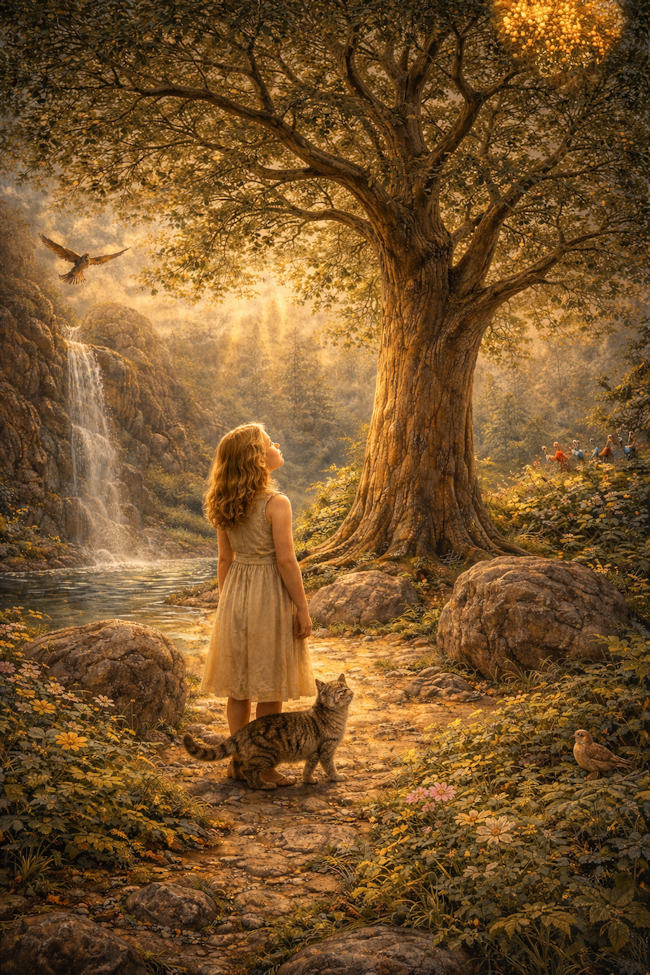
Thus, we can now read in a wonderful way how the soul and living nature work together to achieve the goals of creation. For it is simply the nature of a cat to climb trees and raid nests, and the nature of a falcon to soar through the air as a bird of prey. This theme was already hinted at above with the pigs that helped her in the vegetable garden, as well as with the deer that helped her mother Marie love the prince, and also with the living and carved dogs. What great role do animals play in our world?
In this regard, one could consider the biblical parable of the creation of the animals and the separation of Adam into man and woman. It says: “It is not good for the man to be alone. I will make a helper suitable for him.” (Genesis 2:18) And by “alone,” the “All-One” is probably not meant, but rather a separate being that “wants to do something on its own,” which man, as the “image of God,” should not be. And the “helper”, that this separate being urgently needs, is all of creation, and especially the animals, which are most similar to man and in which he should recognize himself as a holistic, or divine, being: “The Lord God made out of the ground all the wild animals and all the birds in the sky and brought them to the man to see and to determine what he would name them.” Now one could ask: What would have happened if Adam had recognized himself and God as wholeness in all the animals? But he didn’t recognize himself in them, neither physically nor spiritually, and instead gave the animals different names. To help him further, the Creator God divided him into Adam and Eve, and thus he also stood physically before himself. An ingenious solution for self-recognition! “Then the man said, ‘This is bone of my bones and flesh of my flesh.’” Thus, Adam and Eve recognized each other physically and became fertile physically, but not spiritually. And that is perhaps still our great task in this world: that we recognize ourselves physically and spiritually in everything. Perhaps it can also be said this way: God created separation so that we might rediscover wholeness. He created the perishable so that we might rediscover the imperishable. In this respect, God would have given us not only the animals, but all of creation as a “helper” to recognize ourselves within it.
So, Lotte continued her search for the Bird of Truth, to find a way to bring her brothers back to life. Soon she came to a large bush where many colorful parrots were sitting, all calling out at once: “I am the Bird of Truth! - No, I am the Bird of Truth!” until her head felt dizzy. Then she turned away and saw a small, unassuming bird in a low bush. And she knew at once: That is the Bird of Truth. She gave it the golden mistletoe and some of the Water of Life. Then the bird spoke: “I am supposed to be the Bird of Truth? Are you sure?” - “Yes, please tell me how my brothers, who were turned to stone here in the Magic Mountain, can come back to life.” - “You want me to know that?” - “Yes, you know everything. Please tell me what you know.” - “Oh yes, now I remember: With the water from the Spring of Life! Just sprinkle the stone with it.” - “And then?” - “That’s it…” The bird flew away, and Lotte called after it: “Thank you, dear bird!”
Wonderful symbolism! The large bush with its many tangled branches and colourful parrots is reminiscent of our usual inner monologue, with its jumbled thoughts and multicoloured voices, all claiming to speak the truth. If we listen to them, our heads will eventually spin, and dizziness makes it impossible to distinguish between true and false. A small thought bush that can remain silent for a while would be better. Then we could hear a voice, that we call intuition, which comes from a much deeper source than ordinary thoughts. To awaken this intuition and consciously open this source of truth, one naturally needs the golden mistletoe and the water of life, representing a pure soul and a pure spirit, unattached to any preconceived notions. At least, that’s the case if one considers truth to be fundamental: what was before anything came into being and became bound to forms.
How wonderful it is when someone finds this source! Where else would a Jesus, the son of a simple craftsman, have gotten his knowledge? Or a Krishna, who grew up in a humble shepherd’s village? Or something that happened much closer to our home: a Jacob Boehme, who, as a simple farmer’s son, learned the shoemaker’s trade?
In the fairy tale film, the bird is portrayed humorously, but this perfectly captures the simple nature of intuition. Well done! For true intuition, of course, reacts quite differently from our intellectual mind, which believes it knows everything. This is how Lotte learned the way to bring her brothers back to life. Now, some might say: “Oh, Lotte, sprinkling the water of life onto the stone—you could have thought of that yourself!” Yes, but that probably wouldn’t have worked, because it would have been another case of “doing it yourself”, without having found the source of truth.
As fast as she could, she ran to the high rock at whose foot lay petrified Fritz. She sprinkled the boulder with the water of life from her drinking bottle, and lo and behold, he came back to life. But he didn’t know what had happened to him. Astonished, he asked, “Lotte, what are you doing here?” - “I’m so glad you’re alive!” - “Well, what else would I be?” - “Just a moment ago you were a stone.” - “Oh, what nonsense...” Then a bird fluttered up and chirped, “Yes, just a moment ago you were a big, fat stone. That’s right! Or wasn’t it?” Fritz looked at it with wide eyes, cheered, hugged his sister, and cried, “Lotte, you’ve done it! You’ve found the Bird of Truth!”
The drinking bottle containing the water of life is also a beautiful symbol, for the soul, too, drinks from and lives by this spirit that animates everything. Furthermore, one can reflect on how our waking consciousness, our intellect, struggles to imagine that it could be even a lifeless stone. Or is that not true at all?
Lotte said, “Yes, but now quickly, we still have to free Theo!” So, they hurried to the large tree and sprinkled the boulder there as well, the one the cat had shown her. Then Theo awoke again, got up, and asked in surprise, “What are you doing here? I told you I’d do it all by myself. It’s much too dangerous for you here.” Fritz replied, “Yes, as a stone you really don’t notice anything.” Then Theo saw the golden mistletoe sprig and the drinking bottle with the water of life in his sister’s hands. He hugged her and cried, “Lotte, you’ve done it!” She answered, “Yes, the animals helped me. But now we have to hurry, Mother and Father must be worried sick.” But as they turned to leave, Fritz said, “Wait! Didn’t we want to know where we came from?”
Herein lies the great task of the soul in nature: to awaken reason to life. Thus, “Charlotte,” with her name, also serves the “free spirit.” And when reason awakens, it recognizes, as reason, that intellect and soul are always present. This must be so if reason is a holistic consciousness. Then it will also recognize that it itself does not actually act, but rather allows others to act. Intellect plays a part, but fundamentally, the soul of nature, as the principle of causation, does everything, and the free spirit becomes aware of the effects.
Do nothing, and everything is done. (Lao Tzu)
Rightly, intellect criticizes the sleeping or unawakened reason, saying that, like a stone, it perceives almost nothing. That is why we often say that a stone is not alive. But the question of death and life is, in turn, a question of conceptual categorization. From a holistic or reasonable perspective, of course, the entire universe is alive, including every stone.
Finally, one might consider why reason and soul already consider their task in The Magic Mountain fulfilled. For them, it is naturally sufficient to have found the pure spirit and the pure soul along with the truth for self-knowledge. Only the conceptual intellect continues to inquire about the true parents so that the story can continue in the external world.
Then the Bird of Truth appeared, perched on a stone, and Lotte asked him, “Dear bird, who brought us into the world?” He replied, “You want me to know that? ... Oh, I really do know! You are the king’s children.” - “The king’s children?” all three repeated in astonishment. And Fritz added, “You’re just making that up.” - “No, it’s the truth. All three of you are the children of King Alexander and Queen Marie. The king’s mother—I’ve forgotten her name—had you abandoned. She wanted to kill you after your birth, but her servant took pity on you. But your father knows nothing about you.” - “And Marie?” asked Lotte. - “The old queen made Alexander believe Marie was dead. But she isn’t dead at all...” Then Lotte cried, “We must tell the king immediately!” They quickly ran off, and Theo called out, “Thank you, dear bird!”
Well, the Bird of Truth tells us that we are all, in essence, children of the King, the highest ruler in this world, “children of God”, so to speak. But only insofar as the holistic reason of a holistic, or divine, consciousness has awakened within us. Therefore, Fritz‘s intellect still doubts and believes that this is merely a mental construct.
Why couldn’t intuition recall the old queen’s name? In the film, she is called Elisa, which can mean “God helps”. Yes, that is precisely what external nature should be for, just as we recognized all of creation as a “helper” in the biblical parable above. But she herself had apparently forgotten her true nature when she refused to let the royal children and their mother live, so that she no longer deserved that name.
But a Marie, as Mary and Mother of God’s children, cannot truly die. Then there would be no hope left in all of creation. Now the young king simply needs to become aware of this truth in order to be an “Alexander the Great”.
It is also noteworthy that all three royal children now hear the voice of intuition after the soul found the bird of truth, and that Theo, too, now thanks the animals after “awakening” with the help of the soul. Powerful symbolism!
So, at last, all three returned together from the Magic Mountain to the outside world of physicality, where their parents were waiting for them. What a joy! What happiness to be able to embrace their children again! The father cried out, “We thought we’d never see you again!” But Theo said, “Lotte saved us.” Fritz added, “She found the Bird of Truth.” And Lotte revealed, “Imagine, we are the king’s children! The Bird of Truth told us this, and also that Marie isn’t dead at all. We must hurry to the castle!” The parents stood there astonished, gazing thoughtfully at their children. But soon they were all traveling together in a donkey-drawn carriage to the castle gates. There, with many tears in their eyes, the parents bid their children farewell and said, “This path you must now walk alone. But we will always be there for you.”
Here we find again the help of animals pulling the donkey-drawn carriage, just as the royal family travels in a horse-drawn carriage. Our minds have invented many artificial machines to transport us even faster and better, but often without common sense. Accordingly, we also see the downsides of these inanimate machines as environmental pollution: roads crammed with cars, oceans polluted, and the blue sky filled with the scrawls of jet engines. Our souls yearn more for the help of living beings, as the fairy tale suggests. Therefore, the little family travels to the royal castle in the donkey-drawn carriage. But, as in The Magic Mountain, the three royal children must continue their journey alone. And we ask ourselves: Have the biological parents of their children, who cared for them and for whom they were always there, now lost them?
While the children were in the Magic Mountain, and the old queen believed she had achieved her goal, she tried to marry the young king off to a foreign princess she had chosen for him. Alexander repeatedly pleaded in vain, “I will marry no other, for I still love Marie.” But the hard-hearted mother pressed him, “A king needs a queen and an heir! What kind of weakling mourns a simple peasant girl for twelve years! Marie was nothing more than a miserable peasant lass who bore you three dogs. Listen to me, I only want what’s best for you!” But the young king replied, “It’s not about me, only about you and your power. I don’t believe a word you say anymore! You despised Marie from the very beginning.”
Yes, the love between mind and soul is an eternal and imperishable love once one becomes aware of it. - We encountered a similar envy and struggle between outer and inner nature in the Nibelung saga, in the conflict between Brunhild and Kriemhild. They should, in fact, be working together harmoniously. But for that to happen, a holistic reason must prevail. This reason, in this instance, had apparently died as the old king and the enlivening spirit of the old queen, leaving behind, so to speak, a dead nature as ruler. Therefore, she could neither recognize the true nature of Marie nor allow reason to be revived and to assume dominion over a living nature.
Soon after, the three royal children entered the castle courtyard. There, the old queen’s servant came to meet them and asked what they wanted. “Please, we must go to the king at once!” replied Lotte. The servant looked thoughtfully at the three children, and when he noticed the birthmark on the girl, he knelt before them and said, “Forgive an old man his sins! You are the king’s children. I abandoned all three of you many years ago.” And Lotte answered, “You saved our lives, and we are deeply indebted to you. But now we must go to the king, our father.” The servant rose with tears of joy in his eyes and immediately led the three children to the king.
Here we can reflect again on the role of intellect as a servant of external nature. He can kill the royal children at the behest of external nature, or he can take pity on them and set them adrift in the river of life, only to later recognize them and lead them to royalty. Indeed, there is much to ponder about the role of the intellectual mind in our world. It can lead us into the darkness of death or into the light of life. For it serves the physical nature of our transient world in time and space, which exists between eternal darkness and eternal light. Thus, it serves both death and life. What, then, was his sin? It is said that sin is separation from the divine, or rather, from wholeness. And he had separated the children from their mother and father, separating the river, so to speak, from its source. Yet now he brings them together again. Wonderful!
Behind the young king stood the old queen, and when the servant brought the three children into the hall, she was deeply frightened and cried out, “Corbinian (‘Raven’), get rid of this rabble!” But the servant stood and remained silent. The young king recognized the girl he had met by the river. Surprised, he said, “Lotte?!” And she answered, “Yes, and we have something important to tell you: Marie is not dead! The Bird of Truth told us so.” Astonished, the king asked, “You went to the Bird of Truth? And he told you that?” Theo answered, “Yes, Lotte passed all the tests, won the golden mistletoe, received the Water of Life, and spoke with the Bird of Truth.” And Fritz confirmed, “Yes, that’s right.” Then the young king turned to his mother and asked, deeply distressed, “What have you done with Marie?” But she answered contemptuously, “Oh, if only I had drowned those children myself!” Then the king spoke: “You lied to me and cheated me! Where is Marie? Where are my children?” - “She was no woman for you! I sent her to the Magic Mountain. She deserved no better. And I did it for you.” - “You robbed me of everything, my happiness, my wife, and my children. Guards! Guards, take her to the dungeon!” Thereupon, the queen was led away and imprisoned in the dungeon beneath the castle.
Thus, reason awakens in the king, and he recognizes how he has been lied to and deceived by external nature. Indeed, from a holistic perspective of reason, one can recognize the external nature of transient forms as an illusion and consider death a lie. Yet she also says: “I did this for you.” In essence, one can also recognize that external nature truly does this only for the spirit, as a kind of “helper,” so that he can awaken from his dream. Namely, to “self-knowledge,” just as the royal children in The Magic Mountain found their way to truth. And the paradox is that the spirit must lose everything of his own—“my happiness, my wife, and my children”—in order to rediscover everything in the whole. Only then can the rational spirit rise as king above external nature and become the true ruler, because he is no longer ruled. The “guards” ensure this through watchfulness. Excellent symbolism! On the dungeon we will reflect at the end.
Then the king turned back to the three children, and Lotte said, “We are your children: I am Lotte, this is Fritz, and this is Theo.” What joy for the king! Now he also recognized the birthmark on the girl. They embraced each other with happiness, and then the king said, “Now we must find Marie.” At that, Fritz had an idea: “The Bird of Truth can help us.” With the royal carriage, they soon arrived at the Magic Mountain, which they entered together. There they came to the large tree, in whose crown grew the golden mistletoe, and on a stone sat the Bird of Truth. Lotte asked him, “Are you sure that this foundling is Marie?” - “Marie?” chirped the bird, “Should I know? ... Yes, I know: Yes, that’s her!” He flew up and away, and everyone watched him. Then Lotte sprinkled the stone with the Water of Life from her water bottle, and —what a miracle! — there lay Marie on the ground, alive again. The king knelt beside her and said, “Forgive me! My mother made me believe you were dead.” And she replied, “She sent me here to break the curse.” Then the king helped his queen to her feet and revealed, “You are not cursed. Look, these are your children: Theo, Fritz, and Lotte.” Then they embraced and kissed each other with happiness and joy, because they had all been reunited.
Thus, the reigning king now recognizes his royal children as reason, intellect, and soul, which the soul of nature had brought forth for him. And in the Magic Mountain, the queen is revived and freed from her curse that prevented her from bearing only animals. Here, one might ask: What distinguishes humans from animals? Primarily, only the level of consciousness, so that one readily speaks of reason, which humans possess and animals lack. Indeed, may we all find and realize this holistic reason!
Furthermore, one might ask why the royal parents were able to enter the Magic Mountain, while the physical parents were held back by the magic wall. This is likely because the royal parents are more spiritual parents, who then enter the spiritual or inner realm of nature and can hear the bird of truth there.
Meanwhile, the other parents had returned to their farmhouse in the donkey cart, which now seemed quite empty and desolate without their children. As they worked and harvested in their garden, they wondered, “Who will eat all this vegetables?” Suddenly, they heard a horse-drawn carriage approaching and stop in front of the garden. It was the royal carriage, driven by Corbinian. Oh, how great was their joy when their three children jumped out and they all fell into each other’s arms again! Then the king and queen also got out. The children stood among them, and Lotte broke the silence and said, “May I introduce you? These are our parents, Marie and Alexander. And these are our parents, Emmi and Hans.” Then the parents embraced each other, and Marie confessed, “I don’t know how I can thank you.” To this, Emmi replied, “It was our greatest happiness.” Afterward, they went into the beautiful garden of the farmhouse and celebrated a great feast together. They ate, drank, sang, and danced. Old Corbinian came to liven up, and the king’s three dogs felt perfectly at home in the green surroundings. Thus, the fairy tale had a happy ending. And if they haven’t died, they’re still living today…
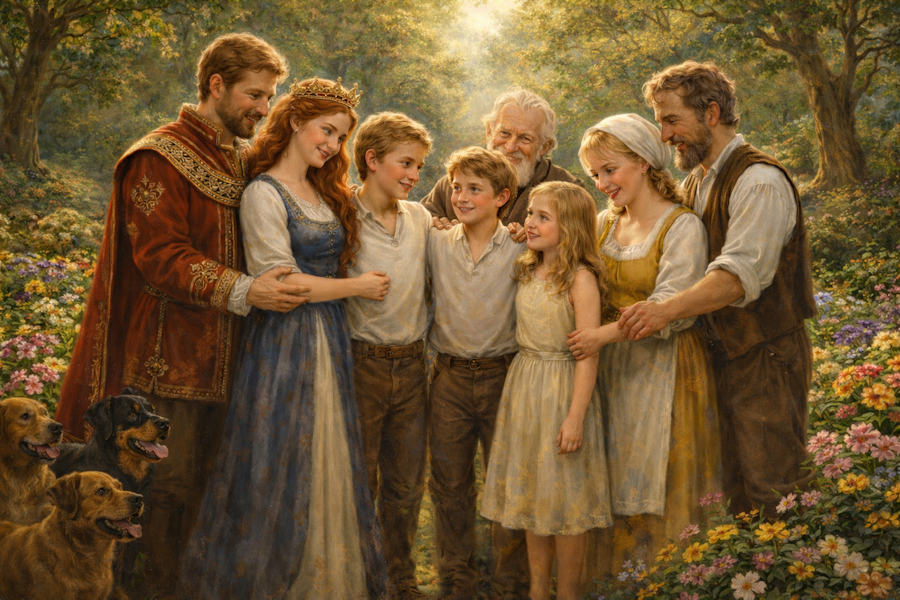
Thus, in the whole, everyone is reunited: the physical parents, who care for the physical world, and the spiritual parents, who care for the spiritual world, as well as their children, who continue their journey together in a living, breathing nature. The small farmer’s paradise becomes a paradisiacal kingdom, and the royal children find their place and their purpose in both worlds. Theo will one day become a good king, Fritz a good advisor, and Lotte the heart and soul of the kingdom. Then reason reigns with intellect and soul in holistic love, and the bird of truth will always be present. Happy ending!
In this respect, we can also reflect on our holistic birth, in which all our ancestors participated. And the entire universe, right up to the Big Bang, has more or less contributed to it. This is also where “self-knowledge” lies, when we recognize who we truly are, who we were before birth, and who we always will be. Happy beginning!
But what happened to the old mother in the castle dungeon? She stood in her magnificent royal gown before the small, barred window and watched as the sun shone from the bright world into the dark dungeon cell. Then she cried out in her imperious tone: “Corbinian, let me out of here! That’s an order! Corbinian!” But he no longer heard her. In despair, she threw herself down onto an old wooden stool and screamed like a madwoman who had lost her mind. A cooing dove sat in the rafters above her. Startled by the screaming, a white dropping fell and hit the queen squarely in the face. Then she closed her eyes and fell silent…
Thus ends the fairy tale film. It is probably a great challenge in every fairy tale to ultimately reconcile and process the supposedly “evil” that drove the story, just as it is a great challenge in our own lives. Corbinian’s intellect, which had served her until now, is no longer of help. But once again, an animal comes to aid, as a recurring theme throughout the entire fairy tale. The dove is often used as a symbol of peace and also of the Holy or the healing Spirit. Can we find the bird of truth in it? At least here, the dove brings humility and peace. Perhaps the old queen can finally live up to her name “Elisa,” meaning “God helps”. What happens now within her, with the “wisdom” on her brow? And what happens outwardly to the old queen in the dungeon? What pure joy could reign in the royal family if their mother and grandmother is imprisoned in the castle dungeon?
Well, we could imagine the following end:
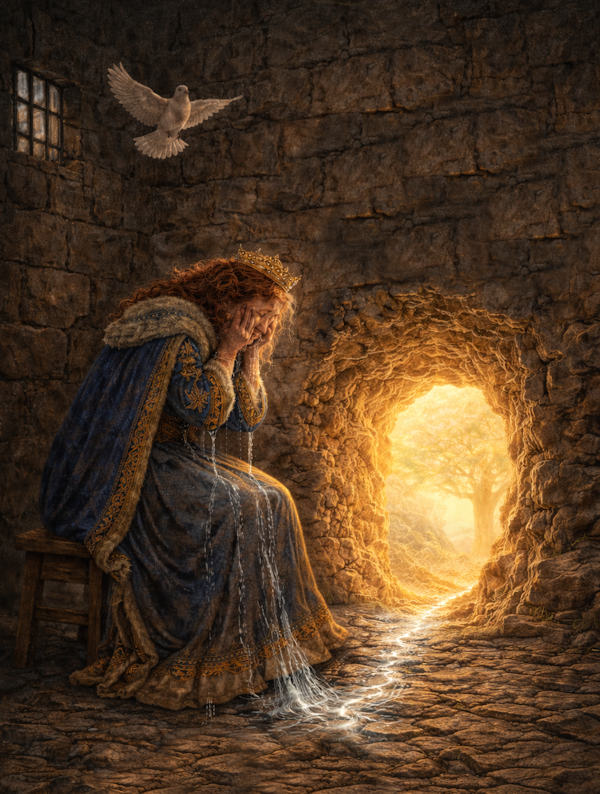
Suddenly, tears flowed from her eyes, for her hard heart was broken. The tears became a river that miraculously opened the cold, thick dungeon wall. A passage appeared, as if leading into a deep cave, and in the depths, a bright light emerged. She rose and walked toward the light. Thus, she too came to the Magic Mountain, and the river of her tears led her to the great tree. There sat an old man, waiting for her. When she looked into his face, she recognized him: It was her husband and king, whom she had lost. In shame, she wanted to hide, but he rose and asked, “Why are you crying?” Then she sank down before him and answered, “I lied to and betrayed our son, cursed our grandchildren, and stained your kingdom with lies. I wanted to rule, but I have lost everything.” But he took her hand, just as he had when they were young, and said, “You have lost, yes, but in doing so, you have gained. For whoever loses their pride finds love.” Then he led her to the fountain of eternal life. And it is said that they still reign today as king and queen, united in the Magic Mountain.
When the young royal couple returned to the castle, they first went to the dungeon to see their mother. But to their surprise, the dungeon was empty, even though the guards assured them that the door had remained firmly locked. Then they heard a dove cooing in the rafters. They looked up at it, and the dove told them everything that had happened. Then it flew away through the barred window…
One and All
(Johann Wolfgang von Goethe)
To find ourselves in boundless being
Who would not vanish, gladly fleeing
From all that wearied and annoys;
No ardent wants, no wild desiring,
No duties strict, no orders tiring,
Such self-surrender each enjoys.
World-soul, come, let your force pervade us!
To combat the world-spirit aid us
And match our powers to these high stakes.
Then sympathetic spirits guide us,
As gentle masters walk beside us
To him who all things made and makes.
To take what’s made and then re-make it,
To fight rigidity and break it,
Eternal living action quest.
What never was grows real and fuller,
As pure clean suns, as worlds with colour,
And in becoming never rest.
It all must move, make new creations,
First take form, then transformations;
For moments it just seems held fast.
In all things life’s perpetuated,
And all must be annihilated
That existence strives to last.
• ... Table of contents of all fairy tale interpretations ...
• The Jew among Thorns - (topic: Reason and Mind)
• The Princess and the blind Blacksmith - (topic: Christmas)
• The Hare and the Hedgehog - (topic: I’m already here)
• Hans my Hedgehog - (topic: Reason and Nature)
• The Simpleton - (topic: Nature of the sea)
• The Water-Nix - (topic: Source and River)
• The Nix of the Mill-Pond - (topic: Water-being)
• The Little Mermaid Undine - (topic: Wave dance)
• Knight Peter and the Sea Fairy - (topic: Knight-love)
• From one who set out to unlearn fear - (topic: darkness and fear)
• Three Royal Children (topic: New Year’s fairy tale 2026)
 |
Text inspiration: Die drei Königskinder, 2019, ARD/SWR |